
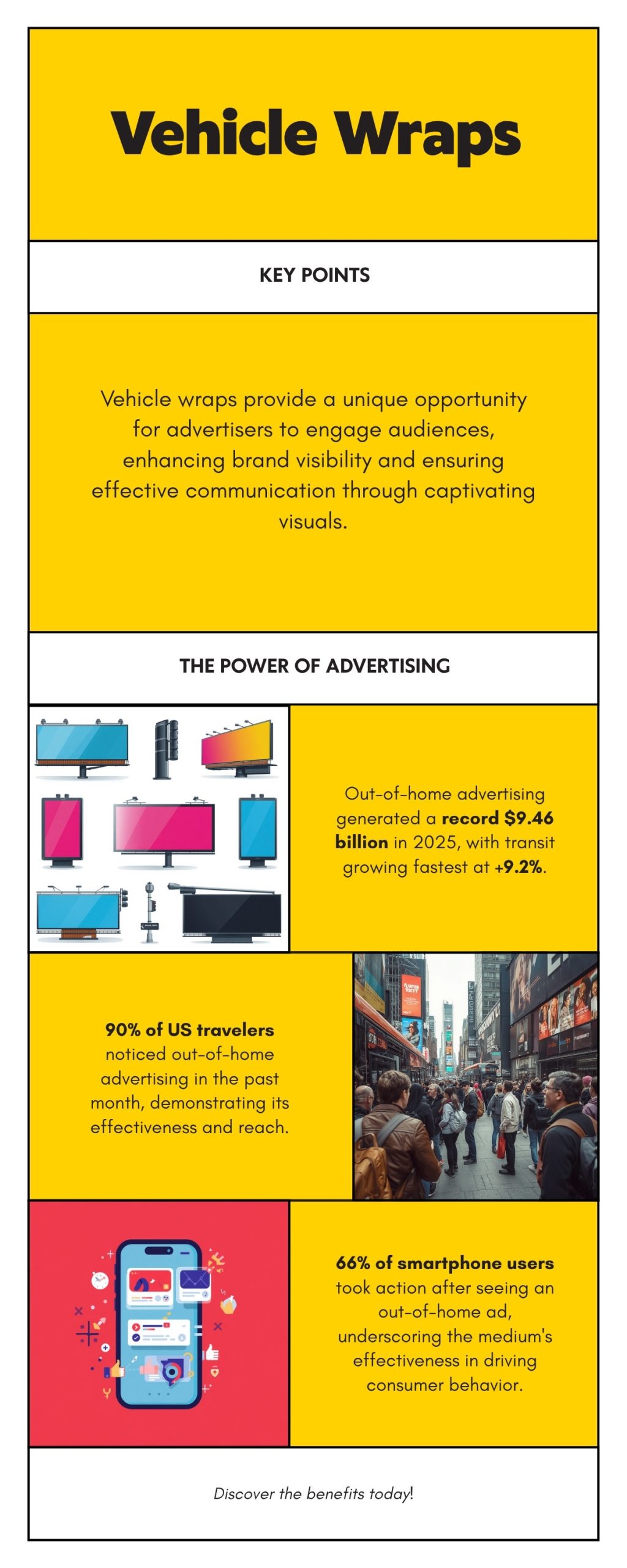
Vehicle wraps turn the trucks, vans, and cars your business already owns into moving brand media. The channel behind them is genuinely healthy, too. Out-of-home advertising revenue reached a record $9.46 billion in 2025, its 19th consecutive quarter of growth (OAAA, 2026). But if you’ve researched wraps at all, you’ve also seen one suspicious number repeated on nearly every wrap website: 30,000 to 70,000 impressions per day. We’re going to be straight with you about where that figure actually comes from, because it isn’t from a study. This guide covers what vehicle wraps are, what verified research really shows, full versus partial versus fleet options, the films we trust, the design-to-install process, and how to care for a wrap.
Key Takeaways
- Out-of-home ad revenue hit a record $9.46 billion in 2025, and transit grew fastest at +9.2% (OAAA, 2026).
- The famous “30,000 to 70,000 impressions a day” wrap claim traces to a decades-old venture-capital estimate, not research.
- Full, partial, and fleet wraps serve different budgets and goals.
- Premium cast films and professional installation determine how long a wrap performs.
What Are Vehicle Wraps and How Do They Work?
A vehicle wrap is a printed vinyl film applied directly over your vehicle’s paint, transforming a car, truck, van, or bus into a rolling advertisement. Our team designs and prints completely custom wraps, as big or as small as you would like, using UV light-resistant, long-lasting materials built for daily road exposure.
The film itself does two jobs at once. It carries your brand message across the busiest streets in your market, and it shields the paint underneath from certain weather factors while it’s on the vehicle. Think of it, as our own service page puts it, as a free mobile billboard that works every time the vehicle moves or parks somewhere visible.
Wraps are also reversible. Because the graphics sit on top of the paint rather than replacing it, a professionally installed wrap can be removed when a lease ends or a rebrand arrives. For a broader look at how wraps fit into the wider print world, see our complete guide to large format printing.
Planning a wrap project? Color Reflections produces and installs vehicle wraps from Philadelphia, Atlanta, and Hollywood FL, with nationwide installation beyond our home markets. Book a complimentary project consultation or find your nearest location.
The Truth About the “30,000 to 70,000 Impressions a Day” Claim
Here’s the honest answer: no published study supports the claim that a wrapped vehicle generates 30,000 to 70,000 impressions per day. The figure traces back to a venture-capital estimate from roughly two decades ago, not to any peer-reviewed research or industry measurement program. It has simply been copied from website to website ever since, often with invented attributions.
Why does that matter? Because the number is usually dressed up with credibility it never earned, often attributed to industry bodies that never ran any such research. When a statistic has no methodology, no sample, and no route data behind it, it can’t tell you anything useful about your fleet in your city.
To be fair, the underlying idea isn’t crazy. Our own vehicle wraps page says a wrap “can generate tens of thousands of impressions every day,” and we stand behind that as a qualitative description of what heavy urban exposure looks like. A box truck running I-95 through Philadelphia, the Downtown Connector in Atlanta, or the corridors of South Florida passes an enormous number of eyeballs. We just won’t pretend that observation is a research finding with a precise daily count attached.
So what should a business owner rely on instead? Verified research on out-of-home advertising as a whole. That evidence is strong, and it’s the subject of the next section.
What Does Verified Research Actually Show About Mobile Advertising?
The verified picture is encouraging. Out-of-home advertising revenue reached a record $9.46 billion in 2025, up 3.6% year over year, and transit was the fastest-growing OOH segment for the second consecutive year at +9.2% (OAAA, 2026). Advertising that moves through traffic is the growth story inside an already record-setting medium.
Attention research backs that up. A Nielsen study commissioned by OAAA found that 90% of US travelers noticed out-of-home advertising in the past month, and 80% noticed it in the past week (OAAA/Nielsen, 2019). People don’t scroll past the physical world. They look at it.
The same Nielsen research measured what happens after the glance: 66% of smartphone users took some action on their device after seeing an OOH ad, and more than 40% searched for the advertised brand online (OAAA/Nielsen, 2019). That search behavior is exactly what a wrapped vehicle with a clear name and web address is built to trigger.
None of these studies isolate wraps specifically, and we won’t claim they do. They measure the out-of-home category wraps belong to, alongside formats like outdoor signage. That honest framing is still a compelling case.
Full, Partial, or Fleet: Which Wrap Option Fits Your Business?
The right choice depends on your budget, your vehicles, and how bold you want to be. Full wraps deliver maximum impact, partial wraps deliver strong branding at a lower investment, and fleet programs multiply either approach across every vehicle you run. In our experience, the best option is usually the one you can execute consistently.
Full vs. Partial vs. Fleet Vehicle Wraps Full Wrap Coverage: entire vehicle Investment: highest Visual impact: maximum Best for: bold rebrands, head-to-tail brand color, flagship vehicles Partial Wrap Coverage: select panels Investment: moderate Visual impact: strong Best for: budget-aware branding, doors, tailgates, rear panels Fleet Graphics Coverage: full or partial, repeated across vehicles Investment: scales w/ fleet Best for: consistent multi-vehicle branding, service & delivery fleets
Full Wraps
A full wrap covers essentially the entire vehicle, replacing its factory color with edge-to-edge printed design. It’s the highest investment and the most memorable format. If your vehicle spends its days in dense traffic, a full wrap gives your brand the whole canvas.
Partial Wraps
A partial wrap covers chosen sections, typically doors, rear panels, or tailgates, and lets the factory paint fill the rest of the design. Done well, a partial wrap can look intentional rather than economical. It’s a smart entry point for a business testing the medium.
Fleet Graphics
Fleet programs apply a consistent design system across every vehicle you operate, whether that’s three vans or three hundred trucks. Consistency is the multiplier here: matching vehicles reinforce each other with every sighting. Fleet work pairs naturally with the broader brand standards we support through corporate graphics programs.
What Materials Go Into a Quality Vehicle Wrap?
Film choice quietly determines everything about how a wrap looks and holds up, which is why we name the films we use rather than hiding behind vague terms like “premium vinyl.” The two workhorses of professional wrapping are cast films from 3M and Avery Dennison, and we print on both.
3M IJ180Cv3 is an industry-standard cast wrap film, trusted by installers for how reliably it conforms to rivets, corrugations, and compound curves. Avery Dennison MPI 1105 is a premium SuperCast film engineered, in Avery’s words, for “maximum durability for complex surfaces with curves and recesses”.
Why cast film rather than cheaper calendered vinyl? Cast films are manufactured in a relaxed state, so they stretch around a vehicle’s contours without fighting to shrink back. Calendered films have their place on flat, short-term applications, but on a curved fender they tend to lift and pucker over time. A protective laminate over UV light-resistant inks then guards the print against sun and road wear.
One honest caution: be skeptical of anyone quoting exact year figures for how long a specific film lasts on a vehicle. Real-world performance depends on climate, exposure, wash habits, and installation quality. Ask your provider which film they’re quoting and what the manufacturer’s warranty actually covers.
How the Design, Print, and Install Process Works
A professional wrap moves through five stages: consultation, design, print, lamination, and installation. The whole process starts with your vehicle’s exact make and model, because every design is built on a measured template rather than a generic outline. We design and print completely custom wraps, as big or as small as you would like.
Design comes first for a reason. A wrap is read at 40 miles per hour, so the strongest layouts favor a big logo, a short message, and one clear way to respond. Our designers proof everything on the vehicle template so you see how graphics flow across doors, handles, and body lines before anything prints.
Printing happens in-house on the same grand format printing equipment that produces our building-scale graphics, followed by a protective laminate. Certified installers then apply the film panel by panel, working edges, recesses, and curves by hand. Because we install nationwide and ship to all 50 states and the Caribbean, a fleet based in Atlanta can have vehicles wrapped to the same standard anywhere. That production discipline carries over to custom wall wraps, too, if your brand refresh extends beyond the parking lot.
Caring for Your Wrap: The Basics
Wrap care is simple, and it’s mostly about gentleness. Hand washing with a mild automotive detergent and a soft cloth is the safest routine. If you must use pressure washing, keep the nozzle well back and avoid blasting directly at edges and seams, where high pressure can start to lift the film.
Parking matters more than most owners expect. A vehicle garaged or parked in shade keeps its color and gloss noticeably longer than one baking in open sun, especially in hot markets like South Florida. Fuel spills and bird droppings should be rinsed promptly rather than left to sit.
Finally, treat small damage early. A lifted edge or a torn panel is usually a quick, inexpensive fix when it’s addressed right away. Wait a season and the surrounding film can degrade, turning a patch into a reprint.
How to Choose a Vehicle Wrap Provider
Choose the provider who shows you real evidence instead of big claims. In our experience, five questions separate professional wrap shops from resellers. Who prints the graphics? Which films are being quoted? Who installs, and are they experienced with your vehicle types? Can you see recent, comparable work? And do their marketing claims hold up?
That last question is the one this guide keeps returning to. A shop still promising you a sourced-sounding “70,000 impressions a day” hasn’t checked its own facts, and that carelessness tends to show up elsewhere. Honest providers talk about routes, coverage choices, and film quality instead.
In-house production is worth prioritizing, too. When design, printing, lamination, and installation live under one roof, color stays consistent and accountability stays in one place. And if events are part of your calendar, our trade show displays and booth guide covers that side of the toolkit.
Frequently Asked Questions About Vehicle Wraps
How much does a vehicle wrap cost?
It genuinely depends, and we’d rather say that than invent a number. Vehicle size, full versus partial coverage, film selection, design complexity, and installation logistics all move the price. The reliable way to budget is a written quote against your actual vehicles, which is exactly what a consultation produces.
Do vehicle wraps damage the paint underneath?
No, quite the opposite in most cases. While the wrap is on, it protects your vehicle’s paint from certain weather factors and light surface wear. Professional removal with proper technique and heat leaves factory paint intact. Problems typically arise only when film is applied over damaged or repainted surfaces.
How long does a vehicle wrap last?
Honest answer: it depends on film quality, climate, sun exposure, wash habits, and installation. That’s why we name the cast films we print on and point you to the manufacturer’s own warranty terms rather than quoting a universal year figure. Ask any provider to do the same.
Can I wrap a leased vehicle?
Usually, yes. Because wraps are removable and protect the paint underneath, they’re a popular branding option for leased vans and trucks. Confirm your lease terms first, and plan for professional removal before the vehicle is returned so it goes back in original condition.
Are full wraps worth the extra cost over partial wraps?
For high-visibility vehicles, often yes; for a supporting fleet, not always. A full wrap maximizes impact on the vehicles your market sees most. Many businesses combine one fully wrapped flagship with partially wrapped support vehicles, keeping the design system consistent across both tiers.
Do wraps really deliver 30,000 to 70,000 impressions a day?
No study verifies that specific range; it traces to a decades-old venture-capital estimate. What verified research shows is that 90% of US travelers noticed out-of-home advertising in the past month, and 66% of smartphone users acted after seeing an OOH ad (OAAA/Nielsen, 2019).
Can Color Reflections install wraps outside its home cities?
Yes. We produce in Philadelphia, Atlanta, and Hollywood FL, and we back that with nationwide installation and shipping to all 50 states and the Caribbean. Multi-market fleets can standardize on one production partner instead of coordinating different vendors city by city.
Ready to Put Your Vehicles to Work?
Vehicle wraps earn their keep the honest way: through verified out-of-home momentum in a record $9.46 billion category (OAAA, 2026), quality cast films, and disciplined installation. Skip the recycled impression myths. Choose the coverage that fits your fleet, insist on named materials, and work with a provider who prints and installs under one roof.
Color Reflections has been helping brands do exactly that for roughly 50 years, from our Philadelphia headquarters and our Atlanta and Hollywood FL facilities, with nationwide installation beyond. Contact our team to start your wrap project, and explore our complete guide to large format printing for the bigger picture.
The post Vehicle Wraps: The Honest Business Guide for 2026 appeared first on Large Format Printing & Event Graphics.