

Large format printing is how brands communicate at architectural scale: wall wraps, event backdrops, retail displays, construction barricades, and graphics that cover whole buildings. It’s also a serious industry. Smithers forecasts the global print market will reach $834.3 billion in 2026, with digital printing’s share of that value climbing from 17.2% in 2021 to 21.6% in 2026 (Smithers). Large format work is a big reason digital keeps gaining ground.
This guide is the complete picture for buyers: what large format printing actually is, how it differs from grand format, which technologies and materials do the work, what it’s used for, the file-prep mistakes we see most often, and how to choose a provider. We’ve been printing big for roughly 50 years, so we’ve seen most of it firsthand.
Key Takeaways
- Large format printing covers output too big for standard presses; grand format is its superwide, building-scale tier.
- Digital printing’s share of the global print market is forecast to grow from 17.2% to 21.6% by 2026 (Smithers).
- Material choice (vinyl, fabric, rigid board, mesh, adhesive film) matters as much as the printer.
- The two most common file-prep mistakes: ignoring viewing distance and forgetting bleed.
- The best providers print, finish, and install in-house across multiple markets.
What Is Large Format Printing?
Large format printing is digital printing at sizes beyond what standard commercial presses can handle. Instead of sheets that fit in your hands, it produces banners, wall murals, window graphics, and rigid displays measured in feet, not inches. Within an $834.3 billion global print market, this digitally printed segment is the part growing fastest by value share (Smithers).
You’ll also hear it called wide format printing. The two terms are used interchangeably in practice. Both describe specialized inkjet equipment that prints on rolls of flexible material or directly onto rigid boards, then hands the output to finishing: trimming, hemming, laminating, mounting, and hardware.
Why does the distinction from ordinary printing matter to a buyer? Because scale changes everything. Color has to hold up across a 40-foot wall, materials have to survive weather and foot traffic, and the final product usually needs professional installation, not a picture frame.
Large Format vs. Grand Format: Where the Line Falls

Grand format is the superwide tier of large format printing. The industry draws the line by output scale: once a project demands superwide rolls or tiled panels that cover building facades, stadium concourses, or multi-story interiors, it moves from large format into grand format printing. Same discipline, bigger machines, bigger engineering questions.
Think of it as a spectrum rather than two boxes. A retractable banner stand and a trade show backdrop sit comfortably in large format. A building wrap, a barricade run around a city block, or a printed scrim covering scaffolding is grand format territory. The graphics get tiled into panels, seams are planned in advance, and structural questions (wind load, attachment, permits) enter the conversation.
For buyers, the practical difference is production planning. Grand format projects need earlier site surveys, more installation coordination, and materials engineered for exposure. If your project might cross that line, involve your printer before the design is finished, not after.
Planning a large format project in Philadelphia, Atlanta, or South Florida? Color Reflections produces everything in-house and installs nationwide from three facilities: Philadelphia, Atlanta, and Hollywood, FL. Book a complimentary project consultation and bring us your roughest idea. Dream it. Print it.
The Technologies and Materials Behind Large Format Printing
Large format production runs on two machine families: roll-to-roll printers that image flexible media from a roll, and flatbed printers that print directly onto rigid sheets. Fabric work often uses dye-sublimation, which bonds ink into polyester textile for rich, washable color. The right pairing of technology and substrate decides how a graphic looks and how long it survives.
Here are the substrate families that cover most projects, described by what they do best:
- Vinyl banner material. The workhorse for indoor and outdoor banners: flexible, weather-tolerant, and easy to hem, grommet, and hang.
- Adhesive films. Pressure-sensitive vinyls for windows, walls, vehicles, and floors. Different adhesives suit different surfaces, from smooth glass to textured masonry.
- Fabric and textile. Dye-sublimated polyester delivers a premium, glare-free look, folds for shipping, and powers SEG (silicone-edge graphics) systems that stretch drum-tight into aluminum frames.
- Rigid boards. Foam boards, acrylics, and aluminum composite panels printed flatbed for signs, displays, and dimensional pieces.
- Mesh. Perforated banner material that lets wind pass through, built for fences, scaffolding, and exposed outdoor sites.
Notice what’s missing from that list: one universal material that does everything. There isn’t one. A floor graphic needs certified slip resistance and abrasion tolerance. A window graphic may need to be seen from one side and see-through from the other. Describe the surface, the environment, and the lifespan you need, and let your printer match the material.
What Is Large Format Printing Used For?
Almost every industry that occupies physical space uses large format printing, and the stakes are measurable. In a FedEx Office survey, 76% of consumers said they had entered a store they’d never visited before based on its signs, and 68% believed a store’s signage reflects the quality of its business (FedEx Office/Ketchum, 2012).
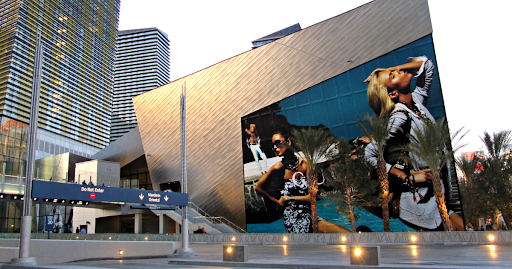
The most common applications we produce across our three markets:
- Wall wraps and murals. Custom wall wraps convert lobbies, offices, and retail interiors into branded environments.
- Event and trade show graphics. Backdrops, banner stands, hanging structures, and booth graphics for conferences, festivals, and live events. Our full breakdown of booth options lives in our trade show displays guide.
- Retail graphics. Window campaigns, point-of-purchase displays, and seasonal changeovers for retail brands.
- Construction barricades. Printed barricade graphics turn plywood walls and jobsite fencing into coming-soon marketing instead of visual blight.
- Floor graphics. Slip-rated floor graphics guide traffic, promote products, and activate the one surface every visitor looks at.
- Environmental graphics. Architectural and environmental graphics that merge branding with interior design: dimensional letters, printed panels, wayfinding.
- Vehicle and fleet wraps. Adhesive film applied to cars, vans, trucks, and buses. We covered the business case, including the truth about wrap-impressions claims, in our vehicle wraps business guide.
Which of these matters most for your business? Usually the one your customers physically walk past every day.
How Big Is the Large Format Printing Market in 2026?
The market context is healthy and increasingly digital. Smithers projects global print at $834.3 billion in 2026, with digital’s value share rising from 17.2% to 21.6% over five years (Smithers). Sentiment inside the industry matches: 46.2% of print companies expect better business conditions, with another 26.5% expecting stability (PRINTING United Alliance State of the Industry, Q4 2024).
For the businesses buying the graphics, the return side has research behind it too. A University of Cincinnati Economics Center study found that businesses that improved their signage reported increases in sales, profits, and transactions of roughly 10% (UC Economics Center, 2012). And in the FedEx Office survey cited above, 52% of consumers said they’d be less willing to enter a store with poorly made signs (FedEx Office/Ketchum, 2012). Quality isn’t cosmetic. It’s a filter customers apply at the door.
What Do Buyers Get Wrong About File Preparation?
The two mistakes we see most: designing without accounting for viewing distance, and submitting files without bleed. Both are cheap to fix before printing and expensive to fix after. Neither requires design software expertise, just a five-minute conversation with your printer before final artwork is built.
Resolution depends on viewing distance, not a magic number. A graphic read from across a parking lot needs far less image resolution than a tabletop display read at arm’s length. Buyers often panic over file sizes for huge graphics, or worse, scale a small logo up until it’s blurry. The fix: tell your printer the final size and how close people will stand, and ask what resolution the artwork needs at output size. Logos and text should be vector whenever possible, because vector art scales infinitely without quality loss.
Bleed is not optional. Bleed is extra artwork extending past the trim line so cutting and finishing never leave a white sliver at the edge. Every shop specifies its own bleed requirements per product, so request a template or spec sheet before design starts.
A few more habits that prevent reprints. Keep critical text away from edges, seams, and grommet zones. Outline or embed fonts so type doesn’t reflow on another computer. Expect some color shift between your backlit screen and printed material, and ask for a proof on the actual substrate when color is critical. Wondering whether your file is ready? Send it early. A good production team would rather flag a problem at the quote stage than at the loading dock.
How Do You Choose a Large Format Printing Provider?
Choose a provider that controls the whole chain: design support, printing, finishing, and installation under one roof. Brokers who outsource production add handoffs, and every handoff adds risk to your deadline. With 46.2% of print companies expecting improving conditions (PRINTING United Alliance, Q4 2024), the field is busy, so vet carefully.
Questions worth asking any shop you’re considering:
- Is production in-house? In-house equipment means direct quality control, honest timelines, and one accountable team.
- Do they install? Printed graphics are only half the job. A professional installation crew, especially for wall wraps, barricades, and grand format work, protects the investment.
- Can they support multiple markets? If you’re rolling out graphics across regions, logistics capability matters as much as print quality.
- Have they done your project type before? Ask for examples of comparable work, not just a general portfolio.
Here’s our own answer to those questions, offered as a checklist example. Color Reflections runs full in-house production with nationwide installation, ships to all 50 states and the Caribbean, and operates three facilities: Philadelphia (our headquarters), Atlanta, and Hollywood, FL. Our roots go back roughly 50 years to a mid-1970s blueprint company called Arrow Graphics, and we’ve grown into one of the largest independently owned large format digital printers in the US. Whatever provider you choose, hold them to that same standard: in-house production, real installation crews, and proof they can deliver where you operate.
Frequently Asked Questions About Large Format Printing
What’s the difference between large format and wide format printing?
Nothing meaningful. The two terms describe the same discipline: digital printing at sizes beyond standard presses, on rolls or rigid boards. Some shops prefer one label over the other, but the equipment, materials, and applications are identical. Grand format is the distinct term, reserved for superwide, building-scale work.
What file format should I send for large format printing?
A print-ready PDF is the safest default, with logos and text as vector art whenever possible. Include bleed per your printer’s spec, outline or embed fonts, and confirm color requirements before exporting. When in doubt, send the file early and ask for a preflight check. Good shops review files before quoting.
How much does large format printing cost?
It depends on size, material, quantity, finishing, and whether installation is included, so credible shops quote per project rather than publishing one-size-fits-all rates. A fabric backdrop, a mesh building banner, and a laminated floor graphic price very differently. Request a quote with your dimensions, substrate, and site details for a real number.
Can large format prints be used outdoors?
Yes, when the material and ink system are chosen for exposure. Outdoor projects typically use weather-tolerant vinyls, UV-resistant inks, protective laminates, and mesh where wind is a factor. Tell your printer the location, mounting method, and how long the graphic needs to stay up, and they’ll spec accordingly.
What is grand format printing, exactly?
Grand format is the superwide tier of large format printing: building wraps, stadium graphics, scaffolding scrims, and block-long barricade runs produced on superwide rolls or tiled panels. It adds engineering considerations like seam planning, wind load, and permitting, which is why grand format projects benefit from earlier printer involvement.
How long do large format graphics last?
Lifespan depends on the substrate, ink system, laminate, and environment, so honest answers are project-specific. An interior fabric graphic lives a very different life than a south-facing outdoor banner in South Florida sun. Tell your provider the intended duration up front and they’ll match materials to it rather than overselling durability.
Does Color Reflections handle projects outside Philadelphia, Atlanta, and Hollywood, FL?
Yes. We produce in-house at all three facilities and ship to all 50 states and the Caribbean, with nationwide installation crews for projects that need professional mounting. Multi-market rollouts, such as retail campaigns or event circuits, are coordinated across our three locations so graphics arrive together and match.
What resolution do I need for a large format file?
There’s no universal number, because required resolution falls as viewing distance grows. A highway-scale graphic tolerates far lower resolution than a countertop display. Give your printer the final output size and typical viewing distance, and ask for their target resolution at full size. Use vector artwork for logos and text.
The Bottom Line on Large Format Printing
Large format printing is where branding becomes physical: walls, windows, floors, fences, vehicles, and buildings. The market behind it is growing more digital every year, the research says well-made graphics measurably move customers, and the difference between a smooth project and a stressful one usually comes down to two things. Prepare files with viewing distance and bleed in mind, and pick a provider that prints and installs with its own people.
Ready to put something big on a wall? Talk to the Color Reflections team in Philadelphia, Atlanta, or Hollywood, FL. We’ll review your artwork, recommend materials, and handle production through installation, anywhere in the 50 states or the Caribbean. Contact us to get started. Dream it. Print it.
The post Large Format Printing: The Complete Guide for 2026 appeared first on Large Format Printing & Event Graphics.